Learn Kinyarwanda online

Empty space, drag to resize
Kinyarwanda is a Bantu language and the national language of Rwanda. It is one of the few African languages spoken by almost everyone in the country. It makes them particularly accessible. In our course you learn how the language is built, what words are important and how you communicate in everyday life. Ideal for business trips or personal interest in Rwanda's remarkable culture. See also SwahiliKirundi, Lingala and Luganda.

Find your appropriate experience

Discover the perfect online language course at Sankofa Lingua Academy that is tailored to your level of experience:

Kinyarwanda for beginners (A1)

  • Skills for daily conversation building
  • Imagine self-confident before
  • Simple sentences form

Kinyarwanda for explorers (A2)

  • Improvement of the Reading
  • In-depth discussions lead
  • Cultural Researching aspects

Kinyarwanda for Champion (B1)

  • Depression of the Text understanding
  • Enhance Your writing skills
  • Basic grammar dominance
 You can change the level of experience within the first two lessons if you find it too hard or too easy.

Three levels, one goal: Kinyarwanda speak

Whether beginners or advanced. Find the online course at Sankofa Lingua Academy that suits you.
STARTE DEINE WEG IN Kinyarwanda

Kinyarwanda for beginners (A1)

In only a few weeks you speak your first sentences on Kinyarwanda and surprises family and friends with a language that only a few Europeans master.


  • Self-confident introduce
  • Simple sentences form and understand
  • Basic word for everyday life
  • The special Kinyarwanda laute pronounce correctly


After this course: You conduct first talks on Kinyarwanda and master simple everyday situations


Discover Kinyarwanda on a new level

Kinyarwanda for explorers (A2)

You already understand the basics? It's gonna be exciting. Discover the culture behind the language and conduct conversations that go beyond Smalltalk.


  • Expenditure Talking
  • Read texts and understand
  • Cultural background and get to know proverbs
  • Vocabulary to expand

After this course: You are more fluent and understand cultural relationships.
Speak Kinyarwanda with clarity and depth

Kinyarwanda for Champion (B1)


Time for the next step. Master the grammar and communicate at a level that impresses native speakers.

  • More complex set structures dominance
  • Own Texts and news write
  • Read more demanding texts and understand
  • Talks diverse topics sovereign guide

After this course: You read, write and speak Kinyarwanda with self-confidence.

African countries

Dialects

Languages in Rwanda 

Spokesperson in Uganda

Kinyarwanda Courses

3 editions: New Year, Summer, Winter
Each edition lasts 10 weeks (about 20 hours)
On average 2-hour sessions per week
Our language courses are designed as group courses.
 For smaller groups, the duration of instruction is adjusted. Don't worry: the teaching quality remains the same.

Number Duration of teaching
1 – 2 participants 60 min
3 – 4 participants 90 min
5 – 10 participants 120 min
10+ participants 120 min + Breakout Groups

New Year Edition (NYE) 2026

16. February 2026
to
3. May 2026

Summer Edition (SE) 2026

01. June 2026
to
02. August 2026

Winter Edition (WE) 2026

14. September 2026
to
29. November 2026

Languages in Rwanda: Kinyarwanda

Rwanda is one of the special cases in Africa. While most countries of the continent are hosting dozens or hundreds of languages, in Rwanda practically the entire population speaks the same mother tongue. About 99% of the Ruander speak Kinyarwanda. Hutu, Tutsi and Twa, the larger three population groups in the country, have shared the same language for centuries, the same words, the same songs. What she separated was never the language.

Kinyarwanda is one of the Bantu languages and originated by the great migration movement that emanated from Central Africa about 2,000 years ago. The region of the Great Lakes has developed its own language variant, which is also spoken today in parts of Uganda, the Democratic Republic of Congo and Burundi. Kinyarwanda is mutually understandable with the closely related Kirundi in Burundi.
At Sankofa Lingua Academy you learn Kinyarwanda from scratch and discover a language that connects a whole country.

How the Kingdom of Rwanda united a language

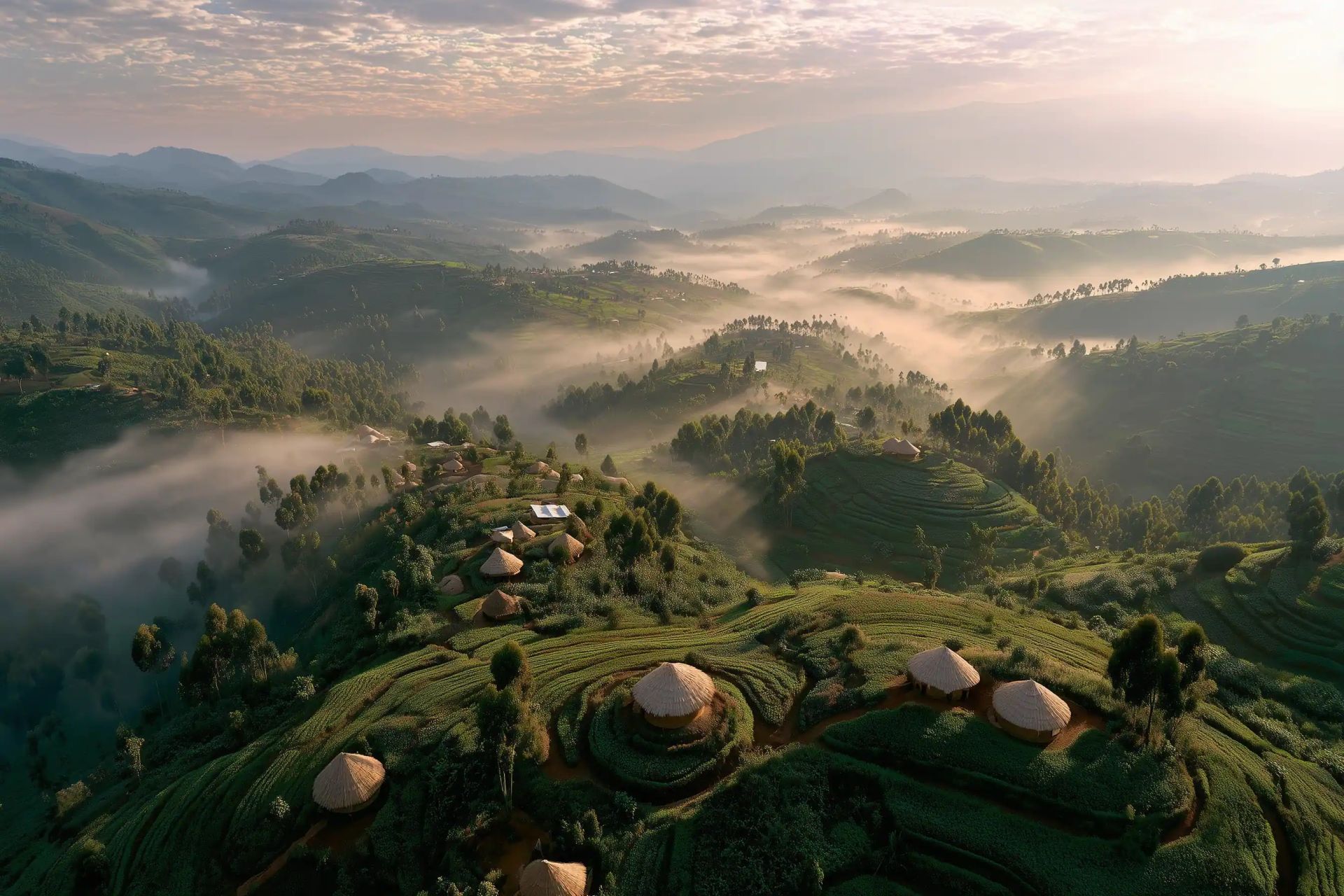
To understand why Rwanda is so uniform, you have to go far back. The region of the thousand hills, as Rwanda is also called, was already settled at 500 BC by Bantu-Sprechern. But the actual history begins in the 16th century when a kingdom was created in the hills near today's Kigali, which should change everything.

The Nyiginya Kingdom under the leadership of the same-named clans grew into a centralized state. At his head stood the mwami, the king. He was more than a ruler. He was considered a sacral figure that throned over the clans and embodied the order of society. His court was in Nyanza, in the heart of Central Rwanda. 
The Society at that time knew three groups. Tutsi were cattle breeders, Hutu were farmers, Twa were hunters and potters. But these categories originally describe no rigid ethnicity, but the profession and economic status of a human being. The boundaries remained permeable. Those who bought cattle could rise. What all connected was the language. Kinyarwanda was the medium of the farm, trade and marriage. A language for a people.

When the empire expanded, Kinyarwanda traveled with us. Especially under King Rwabugiri, who reigned from 1867 to 1895, the kingdom grew enormously through military campaigns and diplomatic treaties. Kinyarwanda became the standard language of the entire empire.
At the Court Nyiginya dynasty there was a private institution for poetry. Her founder was the poet Nyirarumaga in the 16th century. She created Impakaniz, the court podiums whose task was to orally perpetuate the deeds of the kings in Versen.

The Poems were called Ibisigo. They documented military victories, celebrated the kings and told about the mythical origin of the dynasty.
Aside from the farm there was another form of seal. The Imigani, words and fablesand belonged to the people. They taught children morality, simple conflicts and kept the wisdom of the ancestors.

 The caption of Kinyarwanda

Kinyarwanda is a tonal language. How Lingala, Xhosa or Twi the meaning of a word can change depending on whether a syllable is pronounced high or deep. For centuries the language existed only orally.
This changed with the Europeans. In 1911 the French missionary Eugène Hurel published a manual of Kinyarwanda, later followed a complete grammar. Two years later, 1913, the first German-Kinyarwandan dictionary was published by Felix Dufays. The missionaries needed these works to translate the Bible and teach the population. They decided to latin alphabet, supplemented with some peculiarities. For example missing letters Q and X in Kinyarwanda Alphabet.

A uniform spelling came only later. In 1938, Bishop Léon Classe made important orthographic changes that became the basis of the modern writing system. But the spelling remained a sensitive topic. When the government tried to simplify spelling in 2014, it failed to resist the population. 

Kinyarwanda and Kirundi: A language, two names?

Kinyarwanda and Kirundi are so closely related that speakers of both languages understand each other easily can. The separation into two independent languages is largely a result of colonial history under German and later Belgian rule.

Missionaries began to develop grammar and dictionaries for both languages. They created consciously two standard variables from one language. Kinyarwanda has since served as an official marker of identity in Rwanda, while Kirundi fulfils the same purpose in Burundi. This linguistic demarcation became the instrument of national categorisation . Who speaks Kinyarwanda is Ruander, who speaks Kirundi, is Burundian.

Despite the political separation, languages remain remarkably similar. The grammar is almost identical, even if subtle differences exist. While Kinyarwanda has been more influenced by English since 2009, more influences from French and Swahili are found in Kirundi. In the Pronunciation differences. Kinyarwanda sometimes uses longer and more strongly stressed vowels than Kirundi. Some compare the relationship between Kinyarwanda and Kirundi with that between british and American English.

For learners, learning Kinyarwanda an excellent basis for understanding and speaking Kirundi. Those who control Kinyarwanda can easily understand and understand themselves in most everyday situations in Kirundi.

Why Rwanda changed his official language

In 2008, the Rwandan government made a decision that was unprecedented in Africa. From one day to the other English on the primary language of office and education of the country. French, since the Belgian colonial age the language of administration and schools, has been pushed into the background. To understand this radical change of course, one has to look back on 1994.

Genocide to Tutsi not only left thousands of dead, but also one dismantled relationship with France. The new Rwandan government accused France of providing military and political support to the international Hutu regime. French was increasingly perceived as the language of the perpetrators. English, on the other hand, was considered the language of the liberators. After the genocide, hundreds of thousands returned Tutsi back from the decades of exile in Uganda and Tanzania. They spoke English, not French.

Economic reasons also played a role. In 2007 Rwanda joined the East African Community, an alliance with Kenya, Uganda and Tanzania. English became the necessary language of transport for regional trade. But the language change has its price. Studies show that both teachers and students have difficulty using formal Kinyarwanda correctly. The strong focus on English leads to a neglect of the Kinyarwanda mother tongue.

Frequently Asked Questions About Kinyarwanda Course

Language families to Kinyarwanda

Atlantic Congo
  • Cangin
  • Gola
  • Limba
  • Mansoanka
  • Melt
  • North Central Atlantic

Volta-congo
Benue-Kongo
  • Acpes edoid

Bantoid
  • Northern Bantoid

Southern Bantoid
  • Beboid
  • Bendic
  • Bishuo
  • Buru-Angwe
  • Busuu
  • Ecoid mbe
  • Jarawan
  • Mammals

Close Bantu 
  • Bantu A–B10–B20–B30
  • Central-West Bantu

Ostbantu
  • Bottwe
  • Corridor-Bantu
  • Great lega
  • Kilombero
  • Mbugwe-Langi

Northeast Savan Bantu
  • Central Kenya
 Large Lake Bantu
  • East nyanza
  • Great Luyia
  • Gun

Western Lake Bantu
  • Kabwari

Kivu
  •  Forest-Kivu

Western Highlands-Kivu
Kinyarwanda
  •  Bufumbwa
  • Bwisha
  • Hutu
  • Igikiga
  • Mullet
  • Callumbira
  • Rutwa

Sign up for our newsletter

Get weekly updates on live streams, messages and more directly into your mailbox.
Thank you!
Chat with us on WhatsApp