Ga Learn language online

Empty space, drag to resize
If you travel to Accra or to the Ghanas coastal region, Ga will help you. This Niger Congo language is spoken around the capital and is your entry into local culture. We will show you the most important expressions, train the pronunciation and explain how sentences are built. Whether for business, family or travel, with Ga You're talking directly. See also TwiEwe and Hausa if you want to get to know more languages Ghanas.

Three levels, one goal: Ga speak

Whether beginners or advanced. Find the online course at Sankofa Lingua Academy that suits you.
STARTE DEINE WEG IN Ga

Ga for beginners (A1)

In only a few weeks you speak your first sentences on Ga and surprises family and friends with a language that only a few Europeans master.


  • Self-confident introduce
  • Simple sentences form and understand
  • Basic word for everyday life
  • The special Ga-Laute pronounce correctly


After this course: You start talking to Ga and master simple everyday situations


Discover Ga on a new level

Ga for Explorers (A2)

You already understand the basics? It's gonna be exciting. Discover the culture behind the language and conduct conversations that go beyond Smalltalk.


  • Expenditure Talking
  • Read texts and understand
  • Cultural background and get to know proverbs
  • Vocabulary to expand

After this course: You are more fluent and understand cultural relationships.
Speak Ga with clarity and depth

Ga for Champion (B1)


Time for the next step. Master the grammar and communicate at a level that impresses native speakers.

  • More complex set structures dominance
  • Own Texts and news write
  • Read more demanding texts and understand
  • Talks diverse topics sovereign guide

After this course: You read, write and speak Ga with confidence.

Find your appropriate experience

Discover the perfect online language course at Sankofa Lingua Academy that is tailored to your level of experience:

Ga for beginners (A1)

  • Skills for daily conversation building
  • Imagine self-confident before
  • Simple sentences form

Ga for Explorers (A2)

  • Improvement of the Reading
  • In-depth discussions lead
  • Cultural Researching aspects

Ga for Champion (B1)

  • Depression of the Text understanding
  • Enhance Your writing skills
  • Basic grammar dominance
 You can change the level of experience within the first two lessons if you find it too hard or too easy.
African countries
Dialect
Years of Proto-Ga
Languages in Ghana

Courses

3 editions: New Year, Summer, Winter
Each edition lasts 10 weeks (about 20 hours)
On average 2-hour sessions per week
Our language courses are designed as group courses.
 For smaller groups, the duration of instruction is adjusted. Don't worry: the teaching quality remains the same.

Number Duration of teaching
1 – 2 participants 60 min
3 – 4 participants 90 min
5 – 10 participants 120 min
10+ participants 120 min + Breakout Groups

New Year Edition (NYE) 2026

16. February 2026
to
3. May 2026

Summer Edition (SE) 2026

01. June 2026
to
02. August 2026

Winter Edition (WE) 2026

14. September 2026
to
29. November 2026

Languages in Ghana: Ga

In the middle of the pulsating chaos of Accra, Ghanas capital, lives a language with a history ranging from Egypt to Brazil. The Ga once named themselves after the unstoppable "Gaga" ants, a sign of their strength as a warrior culture. Today the Ga is a multiethnic group in the Greater Accra, whose identity is interwoven from many different strands.

Linguistic belongs to Ga-Dangme Kwa languages within the large Niger-Kongo family and is related to Ewe and Twi. Through centuries of contact with the Akan, Ga has taken over numerous terms from politics, military and religion. This makes language a mirror of the Ghanaian history in which peoples, cultures and traditions came together.

At Sankofa Lingua Academy you learn Ga from the ground and discover a language that makes Ghana's heart beat faster.

Why Accra Accra is: The history of Ga

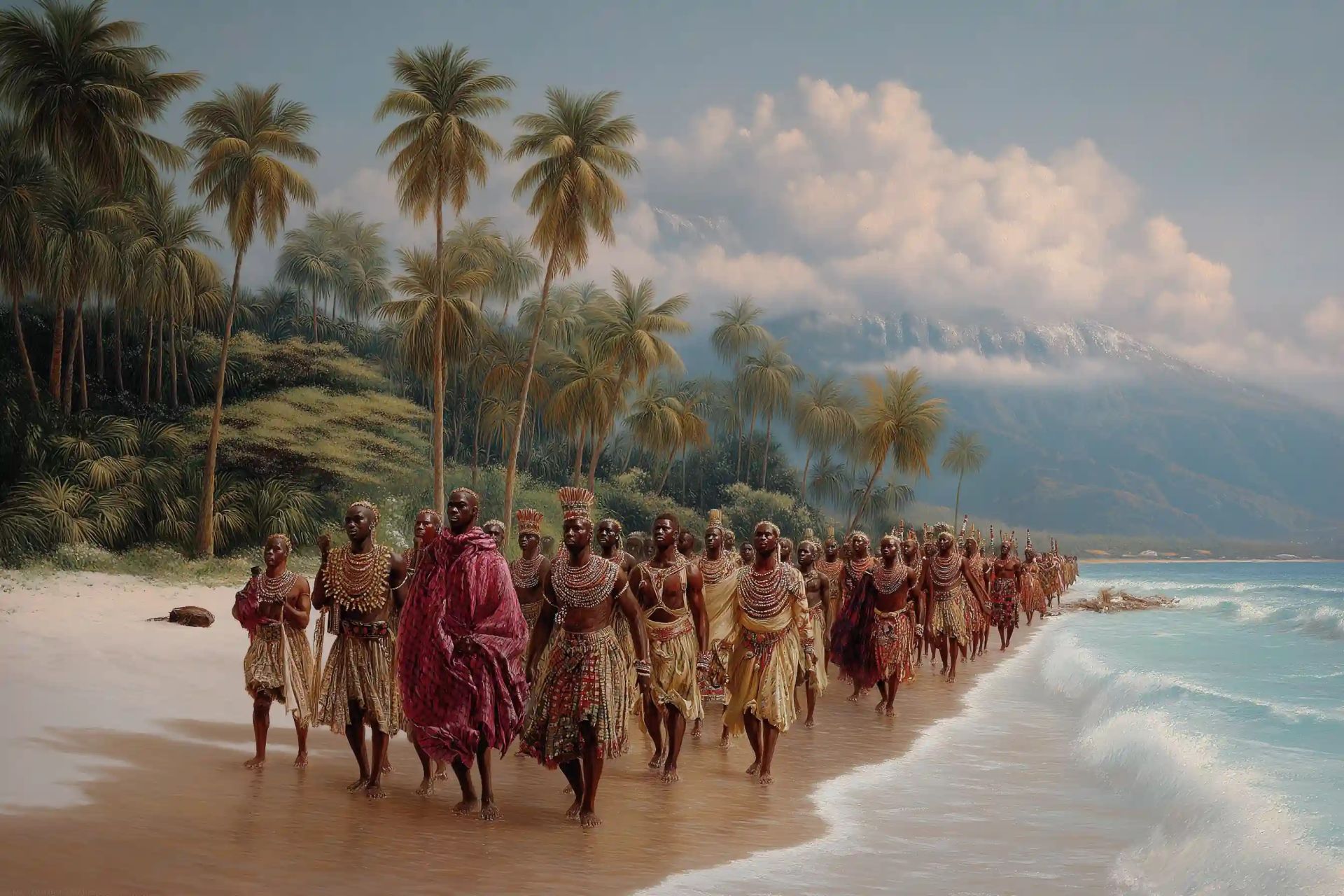
Millions of people travel annually to Accra, but hardly anyone knows that the name of the Ghanaian capital comes from ants. The Ga-Dangme moved centuries ago from the east, probably from Benin City or Ife in today's Nigeria, along the Gulf of Guinea, to today's Accra Great Region. They came in so large numbers that they looked like hiking ants from a distance. In addition, her fighting style was reminiscent of the feared soldier ants who move through the forest in endless columns and slew everything on their way. After this animal The Ga himself called the model “Gaga". The neighboring Akan translated this name into their language and called the people "Nkraine" or "Nkranfou", ant people.

After their arrival, the Ga founded six cities: Ga Mashie, Osu, La, Teshie, Nungua and Tema. The actual power center, however, was not on the coast, but eleven miles in Ayawaso, also known as "Great Accra", where the king resided. The today's Accra was then only a small fishing village called "Little Accra". Only when the Kingdom of Akwamu destroyed 1680 Ayawaso, the political center moved to the coast near the European trade forts.

In the 15th century, Portuguese traders had already reached the gold coast. They heard how the Akan spoke of 'Nkran', they could Do not speak out and made 'Akra'. From Akra became Accra, and so Ghana's capital still bears a name reminiscent of hiking ants.
In the 19th century released slaves returned Brazil back to West Africa. A group of them settled in Accra. When they arrived in Jamestown they only spoke Portuguese and constantly welcomed each other "Tá bom", Portuguese for "all good". The Ga heard this expression so often that they shorthanded the new arrivalsTaboo" called.

The Mantse Nii Ankrah received the taboo and gave them land in privileged locations. To date, Tabom maintains its own identity within the Ghana society.

Ga and Dangme: Separate paths, common roots

The closest relationship of the Ga is to the people of the Dangme. Both of them come from a common ancestor Proto-Ga-Dangme and separated a little more than 1,000 years ago. While Dangme remained more linguistically conservative, Ga continued to develop more innovatively through intensive contact with Akan and Guan groups.

About 8% of vocabulary from today Akan, there are influences from Guantán and Words from English and Portuguese. Also the Kla name, the day name after the weekday of birth, took the Ga from the Akan. Who was born on a Sunday is Kwashi or Akoshia. A common saying in Accra points out: “There is no pure Ga."

Despite this mixing, the Ga differ culturally from their Akan neighbours. The akans are matrilinearly organized, in which Ga determines the paternal line descending and succession. The name system is also its own: Nii for men and Naa for women are honorary titles before the name.

Ga speak and write – this is how the language is built

Ga belongs to the tonal languages West Africa. Two basic tones, high and low, decide the meaning of a word. What sounds like the same sound for European ears can mean something completely different depending on the pitch. Ga shares this principle with neighboring languages such as Twi and Ewe.

Some sounds call for the mouth in a new way. At /kp/ and /gb/, lips and palates close at the same time as saying "k" and "p" in a single moment. Such doubll tolls also come in other African languages such as Yoruba, Igbo and Wolof before.

Ga works differently from German
. In the German we ask "Wann?", Ga asks "Quarterly or not finished?" Just say the verb, the action is complete. If you want to say that you're in, add a prefix. 'Mi ye means 'I have eaten', 'Miíye means 'I have eaten'.

The first written record of the Ga comes from the Year 1764, written by Christian Jacob Protten, an Afro Danehis mother came from a Ga family with Togolese roots. In the 19th century, missionary Johannes Zimmermann and historian Carl Christian Reindorf built on his work. They developed grammars, dictionaries and translated the Bible into Ga. Today's alphabet is based on Latin, extended by special characters calibre, silhouette and vac for soundsthat does not cover the Latin alphabet.

Frequently Asked Questions About Ga Course

Language families to Ga

Atlantic Congo
  • Cangin
  • Gola
  • Limba
  • Mansoanka
  • Melt
  • North Central Atlantic

Volta-congo
  • Benue-Kongo
  • Ega

Kwa-Volta-Kongo

Ga-Dangme
  • Adangme
  • Ga

Sign up for our newsletter

Get weekly updates on live streams, messages and more directly into your mailbox.
Thank you!
Chat with us on WhatsApp